Golden Circle Self-Drive Route: Map, Distance, and Itinerary
Most travelers land at Keflavík, grab their rental keys, and head straight out onto the asphalt with a vague idea of chasing waterfalls. Tackling the golden circle by car gives you something a cramped tour bus never will, which is total control over your own clock. If you want to sit by a boiling mud pot for 47 minutes waiting for the steam to clear, nobody is tapping a wristwatch at you.
The standard loop sounds simple on paper, yet people routinely underestimate the driving rhythm, the sudden wind gusts across the moss fields, and how quickly daylight disappears between October and March. This guide breaks down the actual route, real distances, road realities, and the stops that actually justify getting out into the biting wind.
Book your kerid crater iceland experience:
Route Overview: Golden Circle KM, Miles, and Navigation
The entire loop covers roughly 237 kilometers, which translates to about 147 golden circle miles starting and ending in downtown Reykjavík. If you drove the whole loop without tapping the brake pedal once, your odometer would log about three hours and 20 minutes of pure motion. Nobody drives it that way. Plan on spending seven to nine hours out on the road once you factor in trail walking, soup breaks, and gas station coffee.
First-time visitors often search for a specific golden circle address to plug into Google Maps. There is no single address. The route is a loose regional circuit stitched together primarily by Route 36, Route 37, Route 35, and the main Ring Road (Route 1). If you punch "Golden Circle" into a basic navigation app, it will likely drop a pin in the middle of a birch shrub field near Laugarvatn. Instead, map your day stop by stop using individual landmark names.
Navigating is relatively stress-free because the roads are paved, clearly signed, and heavily traveled year-round. You do not need an off-road beast for the main highway segments during summer, though winter brings an entirely different set of rules involving studs and wind warnings. Studying golden circle maps ahead of time helps you see how the loop bends eastward from the capital before arcing south toward the coastal lowlands.
| Segment | Distance | Est. Driving Time | Parking / Entry Notes |
|---|---|---|---|
| Reykjavík to Þingvellir (Thingvellir) | 48 km (30 mi) | 45 minutes | Paid parking (approx. 1,000 ISK via app) |
| Þingvellir to Geysir Geothermal Area | 60 km (37 mi) | 50 minutes | Free parking and zero entrance fee |
| Geysir to Gullfoss Waterfall | 10 km (6 mi) | 12 minutes | Free parking at upper and lower lots |
| Gullfoss to Kerið Crater | 56 km (35 mi) | 45 minutes | Paid entry (approx. 600 ISK per adult) |
| Kerið Crater back to Reykjavík | 69 km (43 mi) | 55 minutes | Drive via Route 35 and Route 1 south |
Pro tip: Drive the circuit counter-clockwise by heading to Þingvellir first. Tour buses tend to cluster heavily at Geysir between 11:30 AM and 1:30 PM, so arriving early or flipping the route late in the day lets you skip the worst sidewalk crowds.
The Classic Golden Circle in One Day Itinerary
Doing the golden circle in one day is the backbone of Icelandic tourism for good reason. It condenses tectonic rifts, erupting groundwater, roaring glacial melt, and volcanic remnants into a single tank of fuel. Morning light over the mossy plains sets a calm tone that you will appreciate before the midday coaches roll in.
Your first major milestone is Þingvellir National Park. You park on the bluff, step through the Almannagjá gorge, and walk physically between the North American and Eurasian tectonic plates. The ground here pulled apart slowly over millennia, leaving deep fissures filled with crystal-clear glacial water. History runs thick here too, as Icelandic clans founded their national assembly on these rocky ledges back in 930 AD. Spend an hour walking down to the Öxarárfoss waterfall along the wooden boardwalks.
From there, drive east along Route 365 toward the Haukadalur valley. The sulfuric smell hits your nostrils before you even switch off the ignition at the Geysir Geothermal Area. The original Great Geysir mostly sleeps these days, but Strokkur erupts every six to nine minutes like clockwork. You stand behind the low safety ropes, watch the blue water dome bubble up, and wait for it to shoot 20 meters into the air. Keep your camera ready and your back to the wind, unless you enjoy smelling like boiled eggs for the rest of the day.
Ten minutes further east sits Gullfoss. The Hvítá river barrels south from the Langjökull glacier and plunges 32 meters in two violent stages down into a ragged canyon. On sunny afternoons, mist creates double rainbows that hang over the chasm. The lower wooden walkway gets completely drenched in spray, so waterproof outer layers are non-negotiable here even if the sun is out.
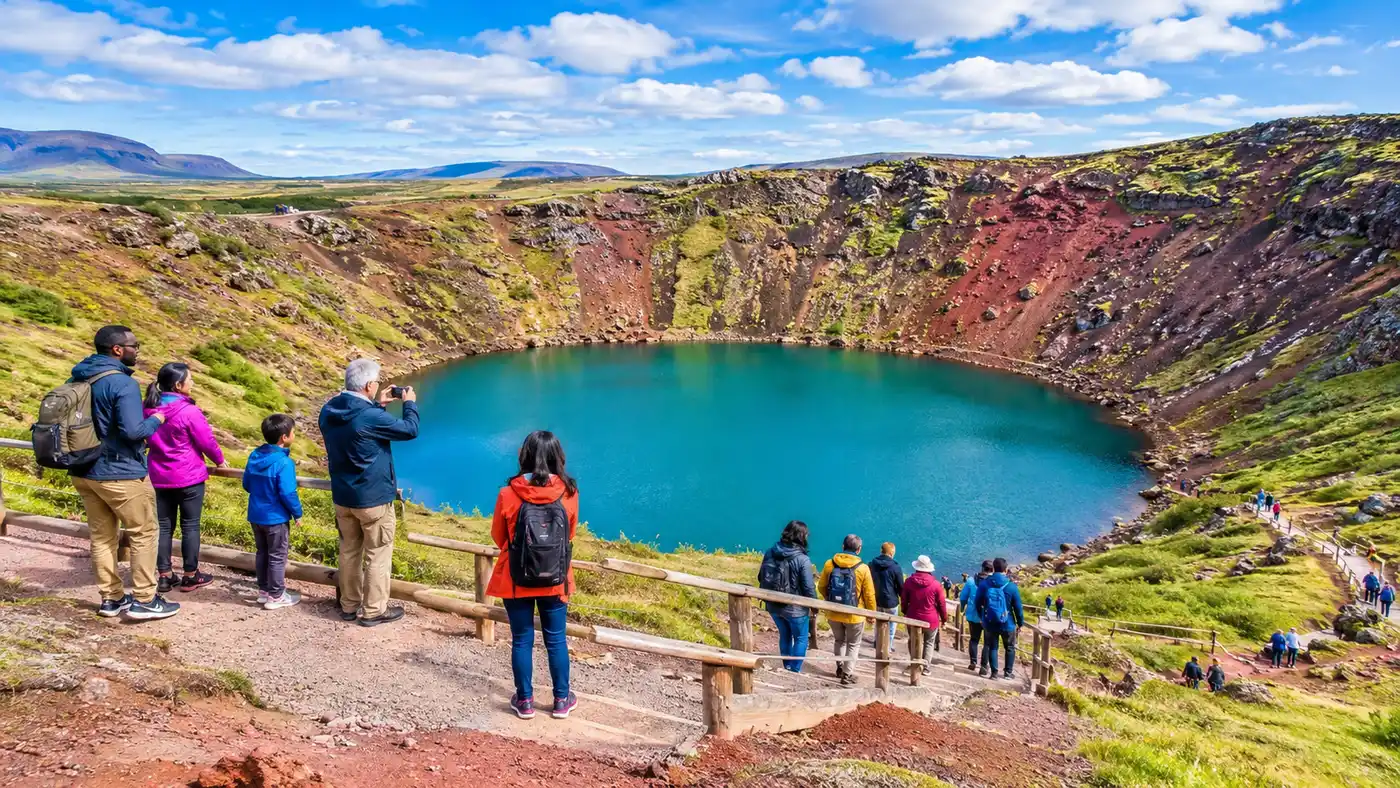
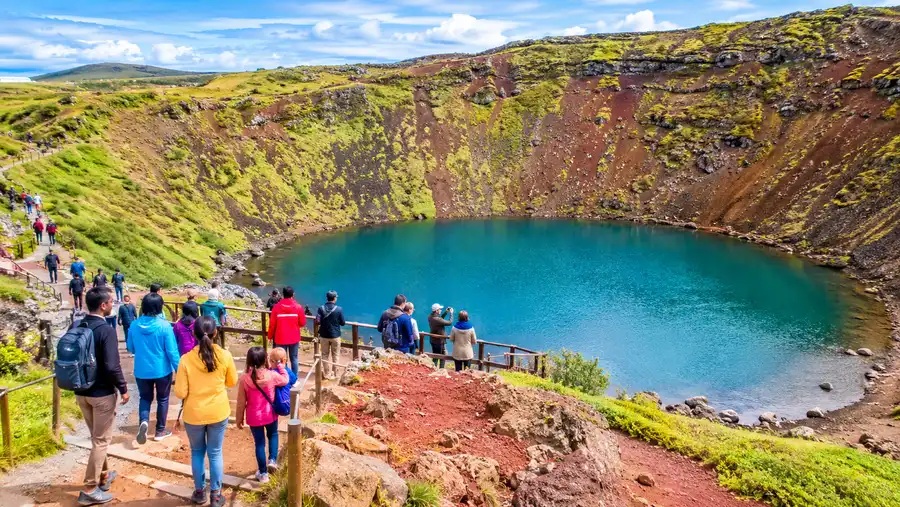
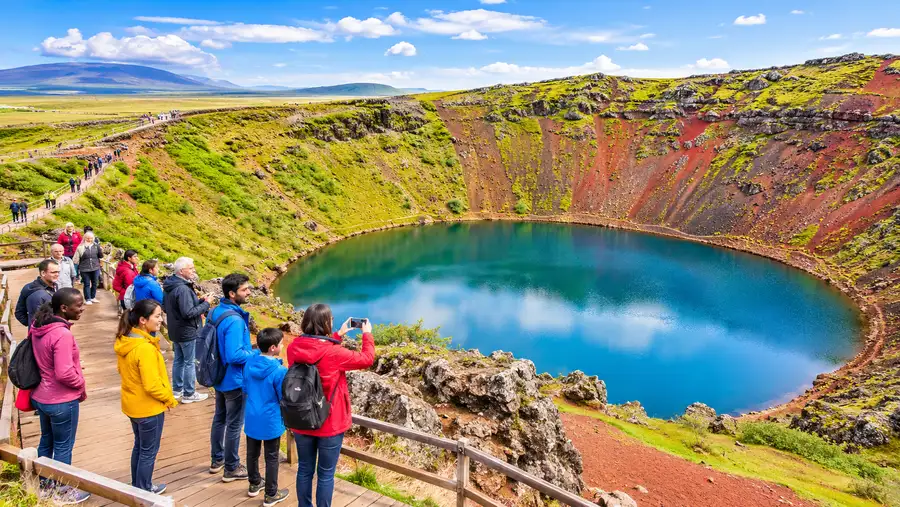
Heading back south, make time for Kerið crater. Unlike the older volcanic landscapes in the north, this crater lake is around 3,000 years old, meaning its slopes still glow with vivid red volcanic rock instead of dull black basalt. The steep walls frame a striking aquamarine lake at the bottom. Before you set off, it helps to check the Kerid Crater entrance fee and ticket guide so you have your card ready at the roadside booth.
Driving Conditions and Practical Road Advice for Golden Circle by Car
Driving on icelands golden circle is generally quite easy compared to the gravel interior tracks of the Highlands. The roads are entirely paved, featuring solid lane markings and reflective roadside markers that become lifesavers in low visibility. Summer driving feels straightforward, much like cruising through rural Scotland or the rolling hills of Montana.
Winter turns the entire route into a different beast. Black ice settles over Route 36 near the lake, and violent wind gusts can blow snow across the asphalt until lanes disappear completely into white drifts. Rental cars in Iceland come with winter tires from November through April, but you should insist on studded tires if you visit between December and March.
Note: Wind speeds on open plains can easily catch car doors and bend the metal hinges backwards against the frame. Always hold the door with both hands when stepping out, especially at exposed canyon viewpoints like Gullfoss.
- Speed limits to memorize: 90 km/h on paved rural highways, 80 km/h on gravel connectors, and 50 km/h inside town limits like Selfoss.
- Weather monitoring habits: Check Vedur.is for wind patterns and Road.is for webcam snapshots of road surface ice before turning your key each morning.
- Fueling logistics: Unattended pumps require a credit card with a four-digit PIN; Apple Pay or debit cards without chips often bounce at rural fuel terminals.
- Single-lane bridges: You will encounter a few narrow river crossings; the vehicle closer to the bridge crossing has the right of way, so slow down early.
Headlights are legally mandatory 24 hours a day, all year long. Police do patrol the 90 km/h stretches of Route 35 and Route 1, and speeding tickets in Iceland are fiercely expensive, often exceeding $400 for modest infractions. Set your cruise control and enjoy the jagged volcanic horizon instead of rushing.
Book your kerid crater iceland experience:
Side Trips and Detours Along the Loop
Sticking strictly to the three main sights leaves some of the region's best flavor on the table. A self-drive trip lets you veer off onto side spurs whenever something catches your eye. Adding two hours of detour time transforms an ordinary checklist vacation into something memorable.
Brúarfoss is a prime example. For years it was a hidden secret tucked behind a private cabin community, requiring a messy four-kilometer hike along a muddy riverbank. Recently, a small paved parking area was built just off Route 37, cutting the walk to a crisp five minutes. The water here is an unreal, icy shade of pale turquoise, channeled down a narrow volcanic cleft right beneath a footbridge.
If you get hungry around lunchtime, pull in at Efstidalur II. It is an active dairy farm where you can eat tomato soup or thick burgers while looking through large glass windows into the cow barn. Their homemade salted caramel gelato is phenomenal, made fresh from the morning milking. If you want to break up the drive across several days, checking where to stay on the Golden Circle gives you solid options ranging from rural farm cottages to sleek modern boutique hotels.
- Secret Lagoon (Gamla Laugin): Located in Flúðir, this warm pool dates back to 1891, featuring a bubbling mini-geysir right at the water's edge.
- Laugarvatn Fontana: Geothermal steam baths built directly over natural steam vents on the shore of a cool lake; try their rye bread baked in the hot sand.
- Friðheimar Tomato Greenhouse: A massive greenhouse warmed by geothermal boreholes where you sit among the vines eating endless tomato soup and freshly baked bread.
- Þjórsárdalur Valley: A longer southern detour toward Hjálparfoss waterfall, far outside the typical tour bus perimeter with almost no crowds.
Most travelers try to cram everything into six hours, but honestly, lingering over coffee at a rural greenhouse while rain batters the glass roof is the real charm of golden circleiceland.
Gas, Food, and Navigation Logistics
You will not run out of fuel on this loop if you use basic common sense, but service stations are not spaced every two miles like an American interstate. The main clusters for gas and hot meals sit around Mosfellsbær on the way out, Laugarvatn in the middle, Reykholt along Route 35, and Selfoss on the southern return leg.
Selfoss is your best bet for stocking up on groceries. It has large discount supermarkets like Bónus and Krónan, where you can buy skyr, flatbread, sliced smoked lamb, and apples for a fraction of the cost of sit-down restaurant meals. Icelandic gas station hot dogs (pylsur) are surprisingly great and cost around 600 ISK, served with crispy fried onions, raw onions, and sweet brown mustard.
Cell phone coverage along the entire golden circle loop is remarkably strong. Even inside the rift valleys and barren moss flats, 4G and 5G signals rarely drop out completely. Download offline maps anyway on your phone before rolling out of your Reykjavík hotel parking stall. Cold temperatures drain phone batteries twice as fast as normal, so keep an external charging pack in your coat pocket when walking out to the wind-whipped edges of Gullfoss.
Parking management has shifted almost entirely to digital cameras across the southwest region. Þingvellir uses automated license plate recognition cameras mounted above the parking entrances. You park, walk around, and settle the fee before leaving using the Parka app on your phone, or by using the physical touchscreen kiosks near the visitor restrooms. Skipping the payment results in an administrative fine sent directly to your rental car agency, which they will charge to your card with a hefty processing markup.
Frequently Asked Questions about golden circle by car
Can you drive the Golden Circle in a regular small 2WD car?
Yes, from May through September a standard two-wheel-drive compact car is completely adequate. The roads along the entire main loop are paved and well maintained. In deep winter, between December and March, a small car can still work if roads are clear, but a four-wheel-drive vehicle offers much better stability on packed snow and icy stretches.
How much does it cost to self-drive the Golden Circle?
Expect to spend roughly $35 to $55 in fuel for the 237-kilometer drive, depending on your vehicle's engine size. Parking at Þingvellir costs around 1,000 ISK (about $7.50), and admission to Kerið Crater is 600 ISK (about $4.50) per person. Geysir and Gullfoss have zero entrance or parking fees, making it an affordable day out.
Should I drive clockwise or counter-clockwise?
Counter-clockwise is the standard choice, taking you first to Þingvellir via Route 36, then to Geysir, Gullfoss, and returning south via Kerið and Selfoss on Route 1. Driving clockwise can work well if you get a late start around 11:00 AM, because you will hit the main attractions after the primary wave of morning tour buses has already moved along.
Quick Reference
- Total loop distance: 237 km (147 miles)
- Pure driving time: roughly 3 hours 20 minutes
- Realistic trip duration: 7 to 9 hours
- Road surface: 100% paved on main loop
- Tolls: zero toll roads on this route
Book your kerid crater iceland experience:
My Advice Before You Drive
Do not treat this road trip like an athletic event where the goal is checking off four famous landmarks and racing back to a city bar. The magic of having your own rental car lies in the random pull-offs, like stopping to photograph Icelandic horses leaning over a wire fence or pulling into a dusty bakery in Hveragerði for fresh cinnamon rolls. Give yourself the whole day, check the wind report before breakfast, pack extra wool socks in the glove compartment, and let the landscape dictate your pace.
Read more about kerid crater iceland.