Top Golden Circle Sights: Waterfalls, Geysers, and Volcanic Craters
Most people arrive in Iceland with a mental picture they cannot shake: rumbling water, plumes of boiling steam, and black rock stretching past the horizon. You get all three within a couple hours of leaving the airport if you spend a day tracing the classic loop east of Reykjavik. The standard 300-kilometer route packs centuries of raw tectonic drama into a day drive, and exploring the best golden circle sights gives you a fast education in how volatile this island really is.
I usually tell first-timers to treat this drive as an introduction rather than a checklist. The crowds can be dense between 10:00 and 15:00 when tour buses roll in from the capital, but the raw landscape does not care about tour schedules. If you give yourself enough time to linger at the rim of an ancient caldera or stand downwind of a glacial torrent, the route feels surprisingly intimate.
Gullfoss and the Power of Golden Circle Waterfalls
You hear Gullfoss long before the ground opens up to show it. From the upper gravel parking area, the view looks like flat moorland cut by low brush, but a deep rumble rattles your ribs. The Hvíta river flows south from the Langjökull glacier, carrying milk-colored meltwater through basalt plains until it takes a sharp right angle and tumbles into a two-tiered crevice. The drop is roughly 32 meters into a gorge that was carved by glacial outburst floods thousands of years ago.
Walking the boardwalk to the lower viewpoint gets wet fast. On breezy days - which is almost every day out here - spray hangs in the air like a wall of mist. I forgot to pull my rain pants on during my first visit and spent the afternoon shivering in soggy denim. If the sunlight cuts through the clouds, double rainbows appear across the canyon, which is where the waterfall gets its nickname, the Golden Falls. It was nearly lost to history in the 1920s when foreign investors wanted to dam the river for hydroelectric power. A local woman named Sigríður Tómasdóttir fought the development for years, walking barefoot to Reykjavik multiple times to protest until the project collapsed. Her stubbornness saved the valley.
While Gullfoss is the heavyweight among golden circle waterfalls, Faxi waterfall sits just 12 kilometers down the road and rarely sees more than twenty people at once. It spans 80 meters wide across the Tungufljót river. Salmon run up the stone ladder built into the side of the falls every summer, and there is a quiet picnic table by the lower bank where you can eat lunch without jostling for elbow room. It proves that the famous golden circle falls are not the only moving water worth seeing along this river basin.
Pro tip: Keep dry lens wipes in a sealed pocket because the mist off Gullfoss coats phone and camera glass within five seconds of stepping onto the lower viewing platform.
Book your kerid crater iceland experience:
Geysir Geothermal Area: Watching the Earth Erupt
The ground here smells faintly of boiled eggs and sulfur, steam drifting across low moss-covered banks. The Great Geysir sits quietly behind a low rope, largely dormant these days because earthquakes periodically clog and unclog its plumbing. Centuries ago, its eruptions reached heights over 70 meters, launching scalding water into the cold Arctic air and giving its name to every geyser on Earth.
Everyone gathers around Strokkur instead. It sits roughly 50 meters away, bubbling violently every 6 to 10 minutes. Watching the water surface is hypnotic. The pool rises, falls back, bubbles furiously, and suddenly domes upward into a brilliant turquoise glass bubble just before bursting skyward. The plume hits anywhere between 15 and 30 meters high. Tourists hold their phones up for agonizing minutes, fingers freezing in the wind, trying to time their video clips just right. You almost always hear a collective gasp from the crowd when it blows, followed immediately by nervous laughter as people scramble backward to avoid drifting vapor.
The walking trails around the geyser golden circle area climb up the red slopes of Laugarfjall hill. Most people skip the climb because their tour bus allows only 45 minutes on site, but climbing the dirt path takes 15 minutes and rewards you with a wide view over the Haukadalur valley. Up there, you see steam vents smoking from fields of red mud, white silica crusts, and vibrant yellow sulfur deposits spread across the tundra like spilled paint.
Thingvellir: Rift Valleys in the Golden Circle National Park
Thingvellir is unsettling because the earth is visibly tearing apart under your boots. This golden circle national park marks the boundary where the North American and Eurasian tectonic plates drift apart by about two centimeters every year. You walk down the Almannagjá gorge between towering walls of black basalt, essentially standing in the empty rift between two continents. The stone faces are cracked, jagged, and flecked with bright green moss.
History here is just as heavy as the stone. In 930 AD, chieftains gathered in this open canyon to establish the Alþingi, one of the oldest surviving parliaments in the world. They chose the site because the acoustics off the rock wall carried speakers' voices across the valley floor, and deep fissures nearby provided freshwater for their horses. Laws were recited aloud from the Lögberg (Law Rock) by memory. Walking past Drekkingarhylur, a deep pool in the Öxará river where condemned women were once drowned for social infractions, the valley feels solemn and strange.
Note: Parking at Thingvellir requires a daily fee paid through Parka.is, and the ticket is valid across all official visitor parking lots within the national park boundary for the entire day.
The rift holds hidden cold-water fissures too. Silfra fissure fills with glacial water from Langjökull that has spent 30 to 100 years filtering through porous underground basalt. By the time it seeps into the lake, it is so pure you can drink it through your snorkel while floating between sheer underwater rock faces. The visibility regularly exceeds 100 meters, which makes floating on the surface feel like you are hovering in thin air over a deep, underwater canyon.
Kerið: The Crimson Golden Circle Volcano Crater
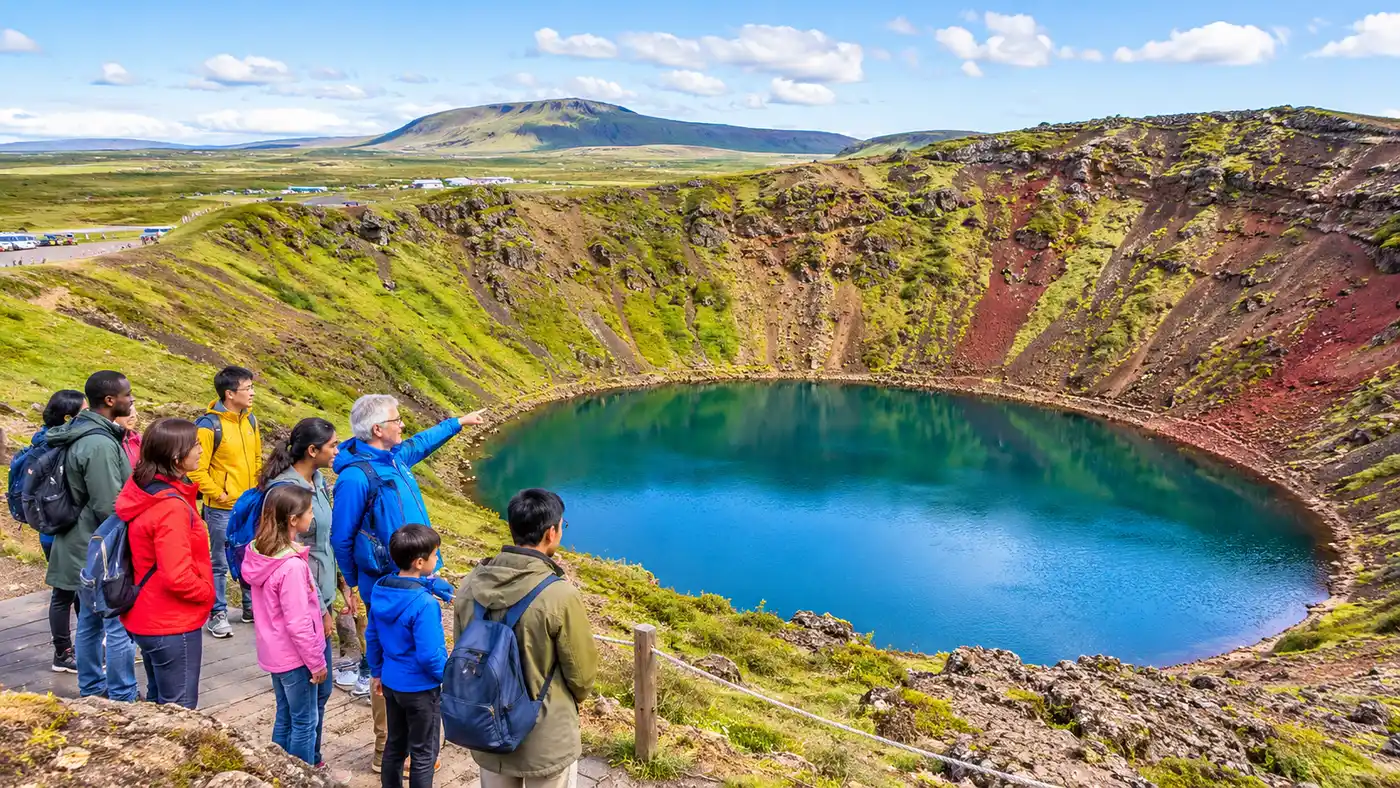
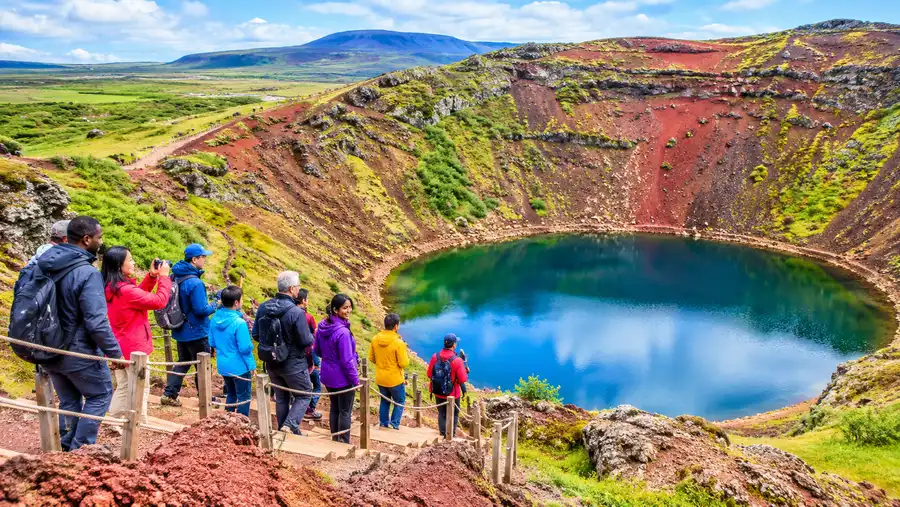
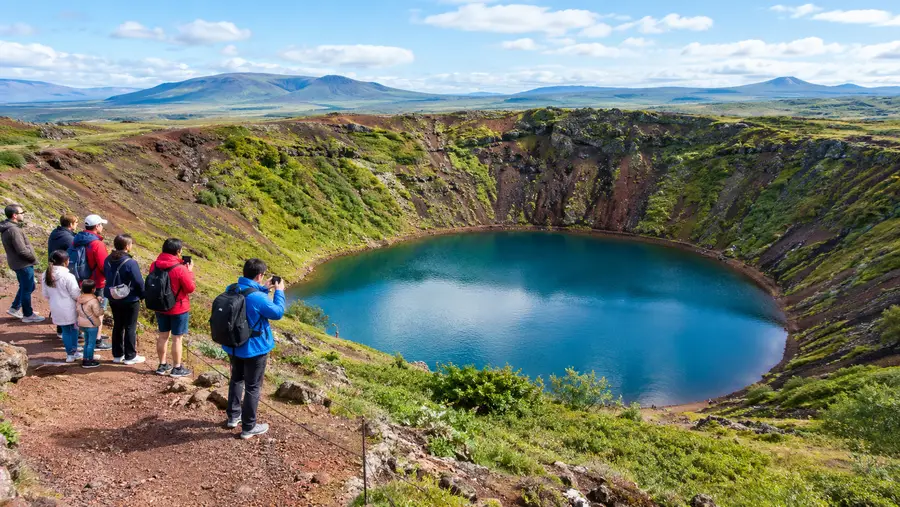
Most travelers rush past Kerið thinking it is just another roadside pit, but this crater golden circle stop has a color palette you will not find anywhere else on the route. The slopes are made of bright volcanic rock rather than drab grey basalt, glowing rust-red in late afternoon sun. Green moss clings to the upper rim, and down at the bottom sits an opaque, aquamarine lake that does not drain away because it rests directly on the local water table.
The caldera formed roughly 3,000 years ago. Scientists used to think an explosive blast hollowed it out, but current research suggests this golden circle volcano simply emptied its magma chamber during an eruption, causing the cone above to collapse inward under its own weight. The rim walk takes roughly 15 minutes at an easy stroll. A wooden staircase leads right down to the water edge where you can sit on a bench and listen to the wind whistle across the crater lip high above your head.
Unlike public lands in the national park, Kerið sits on privately owned property. Landowners charge a modest entrance fee of 450 ISK per person to maintain the walking trails, wooden stairs, and parking facilities. You can read our Kerid Crater Entrance Fee and Ticket Guide for payment methods and timing advice before you arrive. It is an easy stop, taking barely 40 minutes from arrival to departure.
Book your kerid crater iceland experience:
Comparing the Major Golden Circle Spots
The beauty of the classic loop is how easily you can compare the landscape features. Each site demands a different amount of walking, carries its own cost, and shows off a distinct chapter in the glorious geology of iceland's golden circle. If you want to plan your driving schedule cleanly, mapping the distances helps avoid midday bottlenecks.
| Site Name | Primary Feature | Admission Cost | Typical Time Needed | Walking Difficulty |
|---|---|---|---|---|
| Thingvellir National Park | Tectonic rift and history | Free (Parking ~1,000 ISK) | 2 - 3 hours | Easy to moderate gravel trails |
| Geysir Geothermal Area | Spouting hot springs | Free | 45 - 60 minutes | Easy paved and dirt paths |
| Gullfoss Waterfall | Glacial river canyon | Free | 1 - 1.5 hours | Boardwalks with stairs |
| Kerið Crater | Volcanic lake caldera | 450 ISK | 40 - 50 minutes | Stairs and dirt rim path |
| Faxi Waterfall | Wide cascade and salmon run | Free (Parking ~700 ISK) | 30 minutes | Very easy flat stroll |
Distances between these stops are short. Driving between Geysir and Gullfoss takes less than 10 minutes along Route 35, while the leg from Thingvellir over to Geysir runs roughly 50 minutes through open valley. You can map every turn on our Golden Circle Self-Drive Route to see the elevation profiles and seasonal road changes.
Beyond the Big Four: Lesser-Known Golden Circle Sites and Detours
If you stick purely to the four headliners, you will have a solid day, but you will miss the oddities that make southwest Iceland charming. The farmland between towns is littered with quiet surprises if you are willing to turn down unpaved side roads. Little geothermal greenhouses grow sweet tomatoes in middle-of-nowhere villages, powered by steam pumped straight out of their backyards.
Here are three detour stops that break up the drive:
- Brúarfoss Waterfall: known for its electric-cyan water that funnels through a narrow rock crevice; access now uses a convenient parking lot just off Route 37 followed by a brief walk.
- Efstidalur II Dairy Farm: a working cattle barn with a glass-walled ice cream parlor where you can eat salty caramel scoops while watching cows chew hay right below your table.
- Laugarvatn Fontana: hot thermal baths right on the shore of a cool lake, famous for their rye bread baked buried in boiling geothermal sand for 24 hours.
These minor golden circle destinations change the pace of the day. A long drive spent jumping in and out of a car at crowded viewpoints can drain your energy by 14:00. Sitting in a quiet barn sipping coffee or feeling steaming rye bread pulled from wet earth makes the route feel like an actual journey instead of an outdoor museum.
Winter changes everything out here, too. Snow drifts blur the edges of the roads, Gullfoss partially freezes into blue ice sculptures, and the steam from Strokkur hangs thick in sub-zero air. The terrain is stark, windy, and demands respect no matter which season you choose to drive it.
Practical Tips for Driving Golden Circle Sites
Driving southwest Iceland does not require a lifted superjeep in summer, but it does require basic common sense. Sheep wander along unfenced asphalt and dart across without warning. The wind through Thingvellir can catch car doors and bend hinges outward if you forget to hold the handle tightly when getting out.
A few practical habits will keep your trip smooth:
- Timing your departure: hit the road by 07:30 or wait until 14:00 during midsummer to dodge the big tour buses on Route 36.
- Fuel management: fill your tank in Mosfellsbær or Selfoss because petrol stations in the geothermal valley are small, automated, and require a card with a 4-digit PIN.
- Layering strategy: wear an outer shell that blocks water and cold wind entirely, because cotton hoodies become wet sponges near the waterfalls.
- Footwear choices: wear sturdy trail shoes with lugged soles since wet basalt around Gullfoss and Kerið turns into slick grease under worn sneakers.
Honestly, you do not need to rush through these golden circle spots in six hours flat. Pull over at the scenic pullouts along Lake Thingvallavatn. Watch the ravens ride thermals off the cliffs. Let the landscape dictate your pace.
Book your kerid crater iceland experience:
Frequently Asked Questions about golden circle sights
Can you see all the top golden circle sights in one day?
Yes, easily. The standard loop covers about 230 to 300 kilometers depending on your detours, taking around 3.5 hours of pure driving time. With stops at Thingvellir, Geysir, Gullfoss, and Kerið, the trip usually takes between 7 and 9 hours total from Reykjavik.
Do you need a four-wheel-drive car to visit golden circle sites?
During the warmer months between May and September, a standard two-wheel-drive sedan handles the entire paved route without problems. In winter, a four-wheel drive with studded winter tires is strongly recommended due to black ice, high winds, and drifting snow.
What is the admission fee for golden circle sights?
Thingvellir, Geysir, and Gullfoss have free admission to the sights themselves, though Thingvellir and Faxi charge small parking fees. Kerið Crater charges an entrance fee of 450 ISK per person to walk the crater rim and descend to the lake.
Quick Reference
- Total driving distance: 230 to 300 km round-trip from Reykjavik
- Typical route duration: 7 to 9 hours
- Only entry-ticket stop: Kerið crater (450 ISK)
- Peak bus crowd hours: 10:00 to 15:00
Before You Hit the Road
The Golden Circle is famous for good reason, and dismissing it as a crowded tourist trap misses the point. Stand by the roaring edge of Gullfoss or feel the heat vent from the earth at Geysir, and you are seeing the raw planetary forces that built Iceland. Rent a car, leave before the sunrise or well after breakfast, bring waterproof gear, and take your time across this wild volcanic corridor.
Read more about kerid crater iceland.